Last week’s blog was about changes in Conservation Awareness Index (CAI) scores from 2015 to 2020 in the New York City Watershed. This blog summarizes findings from the WAC Forestry Program’s third CAI deployment in 2025.
We completed the third CAI deployment from February to April 2025. 3,000 CAI surveys were mailed to NYC Watershed landowners with a tax parcel containing at least 10 woodland acres. We received 563 completed surveys. Completed surveys have decreased over time (920 surveys in 2015, 793 in 2020, and 563 in 2025).
Average CAI score was 17.3 in 2025, which means that CAI scores increased by 1.5 points over the last decade. That’s not very much. CAI sub-scores indicated that respondents were least prepared to make an informed decision about 480-a and conservation easements, with relatively higher preparedness for timber harvesting and estate planning. The lower scores for 480-a and easements makes sense considering that 56% of respondents had less than 50 forest acres in New York State, which is the minimum requirement for 480-a. WAC forest conservation easements require at least 100 acres. Of all question types (Familiarity, Knowledge, Experience, and Ability to Connect with Forestry Professionals), respondents’ scores were lowest for connecting with professionals.
Note that if you require a forest conservation professional in the NYC Watershed region, please consider checking out the MyWoodlot Directory. We have contact info for foresters (those who mark trees for felling), loggers (those who cut trees and bring them out of the woods), arborists (those who maintain or take down trees impacting buildings and infrastructure), certified pesticide applicators, firewood providers, and timber stand improvement contractors (those that fell poor-quality trees in your woods).
As shown previously, second-hand experience, or knowing someone else that completed a conservation option, improved landowners’ familiarity, knowledge, experience, and professional connections for all four conservation options. Put simply, peer-to-peer information transfer is effective for increasing CAI scores.
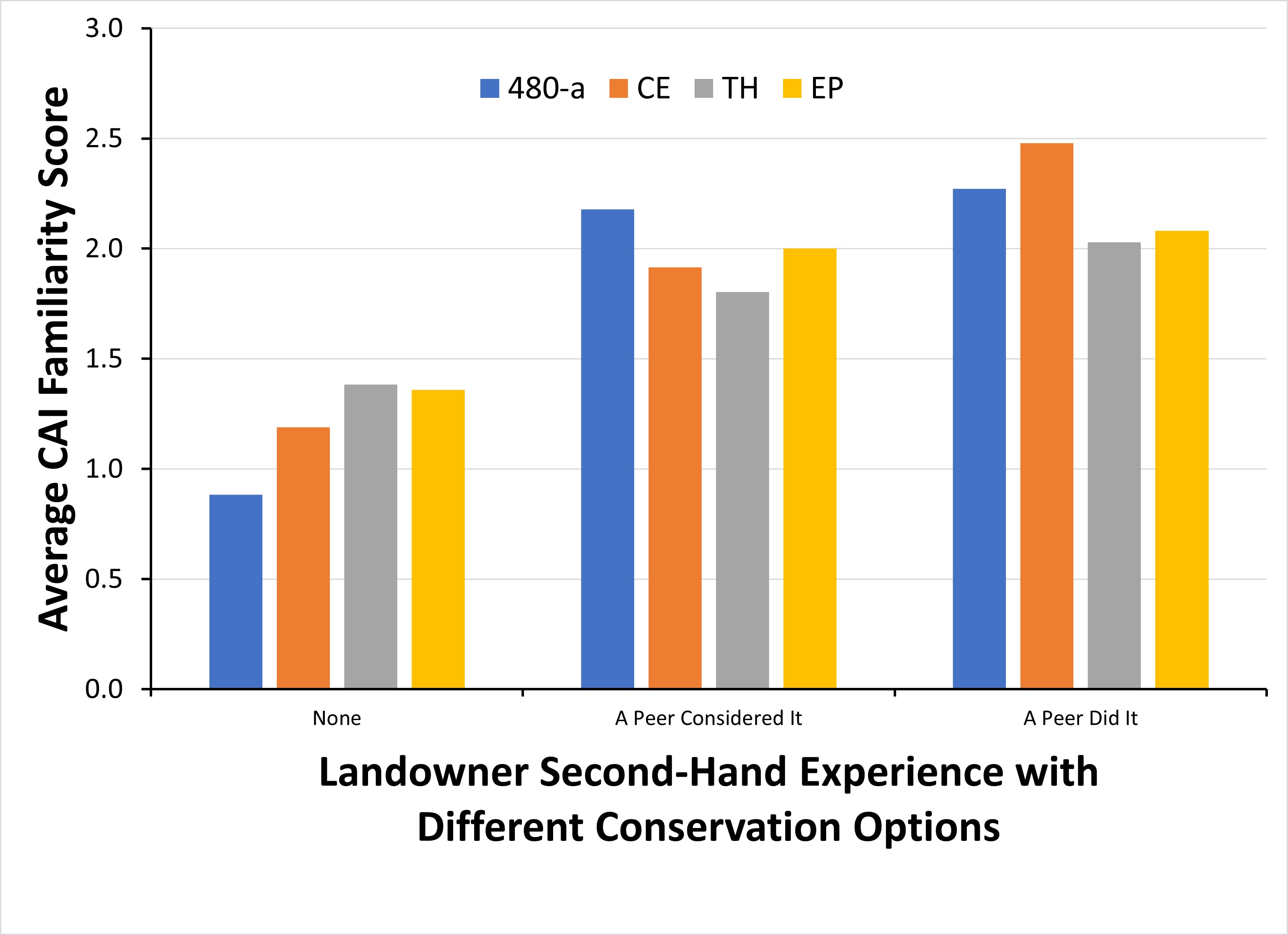
Image shows average CAI familiarity score by conservation option (480-a, Conservation Easements, Timber Harvesting, Estate Planning) for landowners with a gradient of second-hand experience (None, A Peer Considered It, A Peer Did It). Landowners that knew a peer that had completed a forest conservation option had higher CAI familiarity scores for that activity.
The percentage of respondents that knew something about MyWoodlot increased from 9% in 2020 to 14% in 2025. Those familiar with MyWoodlot had higher CAI scores (avg = 30) than those that were not (avg = 15). While we cannot claim that MyWoodlot alone has increased CAI scores, we can’t say that it didn’t help either, as we actively promote 480-a, conservation easements, timber harvesting, and estate planning on the website. We can say that people that know about MyWoodlot appear to be tuned in to conservation.
So, champions of conservation, please help us spread the word about conservation alternatives that landowners have for their land, like 480-a, conservation easements, timber harvesting, and planning for the next forest owner. Share your experiences with these programs / activities and with landownership in general and help people get connected with the conservation professionals they need, when they need it! This is precisely what Master Forest Owner volunteers do! Thanks for your help.
Since 2020, changes to landowner demographics include an increase in older landowners (two-thirds of respondents are at least 66 years old) and a decrease in average woodland acres owned in New York State from 106 to 85 acres. Note that the median of 40 acres has not changed. Respondents with larger acreages had higher CAI scores. Those owning more than 100 acres had the highest scores (avg = 25).
If you would like a full version of the 2025 CAI report, please email me at