The WAC Forestry Program first used the Conservation Awareness Index (CAI) survey in 2015 to evaluate landowner preparedness in the New York City Watershed to make informed decisions about the long-term future of their woods. Specifically, ones that keep forestland intact long-term, as opposed to subdivision, sale, and development. WAC repeated the survey in 2020, and this blog summarizes study findings.
The Conservation Awareness Index (CAI) survey was developed in 2012 by Tyler Van Fleet and others at the Family Forest Research Center at UMass-Amherst. The survey covers four different conservation options available to family forest owners, who are also known as non-industrial private forest landowners. The conservation options vary in terms of the length of time they ensure forestland stays intact, as opposed to being subdivided, sold, and developed. For example, a timber harvest might provide short-term income to help pay for property taxes or a significant life event like a new car, medical bills, or college tuition.
Enrollment in New York’s Forest Tax Law Program, known as 480-a, is another conservation option for landowners with at least 50 contiguous forest acres. 480-a functions like a short-term conservation easement in that landowners agree to avoid subdividing their enrolled forest acres to anything smaller than 50 forest acres and to manage the woods in accordance with a 480-a forest management plan. Every year the landowner accepts the 80% reduction in taxes on the enrolled forest acres, they agree to manage their woods for another 10-year period. The goal of 480-a is to support the New York forest products industry, so enrollment means that the land will be managed to produce timber, in addition to other values like water quality protection, biodiversity, wildlife habitat, aesthetics, and more.
Generally, conservation easements are either sold or donated by a landowner to a qualified conservation organization (a land trust or government agency) and constitute a voluntary legal agreement that limits or conditions certain types of uses of the land, in perpetuity, in order to fulfill the conservation purposes of the easement.
Conservation easements preserve land for future generations by restricting or conditioning certain rights or uses, such as the right to subdivide or develop the property, to protect conservation values, such as the preservation of agricultural and forestry lands and the protection of water quality. Landowners retain many of their rights, including the right to own and use the land, sell it, and pass it on to their heirs. A conserved property continues to provide economic benefits to both the landowner and the greater community. The land remains on the tax rolls in private ownership. As a legally binding document, a Deed of Conservation Easement is recorded at the county in which the property is located and becomes identified as a permanent interest in the property’s record. Once a conservation easement has been sold or donated, the qualified organization (that holds the easement) is obligated to defend its conservation purposes through stewardship (https://nycwatershed.org/conservation-easements/what-is-a-conservation-easement).
Estate planning, also called legacy planning or succession planning, is basically planning for the next forest owner, which might be your children, a relative, a friend, or a stranger. If you have a conservation easement, that agreement stays with the property and the terms must be followed by the next forest owner.
If you want to learn more about any of the conservation options discussed above, please check out these links:
- Learn if I Can Harvest My Trees
- Harvest Trees
- Planning for the Next Forest Owner (Legacy Planning)
- So many valuable publications from the Family Forest Research Center
Let’s get back to the Conservation Awareness Index (CAI) survey and what it asks landowners to do. The survey has four sections: 480-a, Conservation Easements, Timber Harvesting, and Estate Planning. Each section has four question types: Familiarity, Knowledge, Experience, and Connecting with Professionals. Landowners rate their familiarity with each conservation option. They answer four True/False questions about each conservation option. Landowners indicate the level of first-hand or second-hand experience they’ve had with each conservation option. Landowners demonstrate if they can name a New York State forester, a private consulting forester, a local land trust, and an estate planning professional knowledgeable about forest conservation. Do you know any of these professionals? If not, do you know how you’d find out about one? A background section asks landowners to indicate how many woodland acres they own in New York State, when they obtained their woodland(s), how far away they live from their woods, their familiarity with MyWoodlot.com, as well as age, education, and gender.
What is a good CAI score?
CAI total scores can range from -20 to 64. Van Fleet et al. (2012) found that 37 benchmark landowners, or those that had graduated from Massachusetts’s Keystone Project (similar to New York’s Master Forest Owner program), had an average CAI total score of 47, versus 20 for 267 random western Massachusetts landowners. Schnur et al. (2013) found that 79 Master Forest Owner Volunteers had an average CAI total score of 38, versus 15 for 271 random landowners from six contiguous towns in Schuyler and Chemung counties in the southcentral Highlands region of New York.
What have previous CAI studies shown?
Van Fleet et al. (2012) - the team that developed the CAI - found that random landowners in western Massachusetts knew the least about estate planning and conservation easements. Landowners knew the most about timber harvesting and property tax reduction programs. CAI scores were related to how far people lived from their land, education level, ownership size, and location.
Schnur et al. (2013) found that New York forest landowners knew less about conservation options for their land than Massachusetts landowners. Random landowners knew the least about 480-a and conservation easements.
Kittredge et al. (2015) surveyed forest landowners in Massachusetts across a range of rural to urban communities. They found that CAI scores differed by town, suggesting hotspots of awareness. Towns with higher CAI scores were associated with greater conservation social capital and relative wealth. Conservation social capital means having access to informed peers and professionals through groups or programs. In the NYC Watershed region, examples include WAC, Catskill Forest Association, Cornell Cooperative Extension (CCE), CCE’s Master Forest Owner Program, Women Owning Woodlands, and the Women and Their Woods Retreat.
How can forest conservation programs apply CAI score data?
As described by the Family Forest Research Center, “CAI estimates woodland owner awareness of their conservation alternatives for their land. Modeled after the Consumer Confidence Index that estimates confidence in the economy, CAI estimates knowledge and awareness of conservation alternatives and experience with them. CAI can be deployed in a landscape to estimate landowner awareness, and identify gaps in understanding, enabling targeted outreach response. It can also be used to estimate awareness change over time during or following an outreach campaign”.
How has the WAC Forestry Program used the CAI Survey?
In the winter of 2015 and 2020, the WAC Forestry Program mailed the CAI survey to 3,000 landowners with a parcel having at least 10 woodland acres in the NYC Watershed, which includes the Catskill and Delaware River Watersheds (aka the West of Hudson NYC Watershed) and the Croton River Watershed (aka the East of Hudson NYC Watershed). We used county tax parcel information to randomly select family forest owners and exclude public and industrial landowners. The 2015 deployment established a baseline set of scores and the 2020 deployment evaluated changes in CAI scores over time. This was a novel research project in that no other study had repeated such a large-scale CAI deployment to evaluate awareness change over time.
Results
Based on a sample size of 793 NYC Watershed landowners, the average CAI total score in 2020 was 16.5, which is slightly higher than in 2015 (average = 15.8). This suggested that relatively little had changed in terms of landowner conservation awareness. The exception was that 480-a sub-scores increased in 2020. CAI sub-scores were highest for estate planning and timber harvesting and lowest for 480-a and conservation easements. CAI scores were related to landowner education, ownership size, age, and the distance that landowners lived from their woodlots.
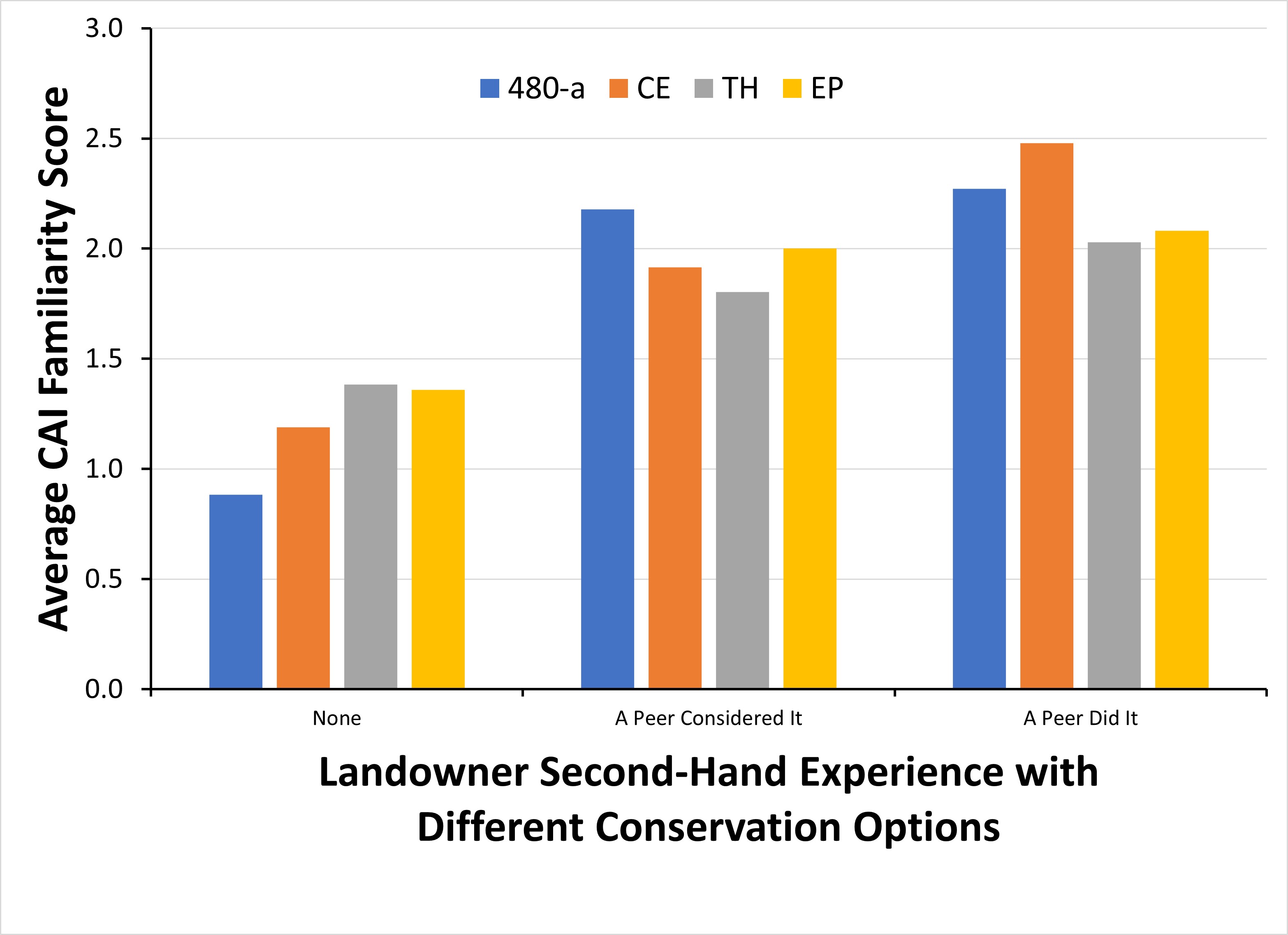
While CAI scores in the NYC Watershed were lower than in Massachusetts (Van Fleet et al. 2012, Kittredge et al. 2015), our findings related to second-hand experience suggest that a focus on fostering peer-to-peer relationships may be a viable option for increasing CAI scores in the Watershed. Specifically, we found that when landowners knew someone else that had considered or completed a forest conservation option (e.g., 480-a enrolment, conservation easement, timber harvest, or estate plan), it improved their familiarity, knowledge, first-hand experience and ability to connect with forest conservation professionals related to those subject areas.
The percentage of survey respondents that knew anything at all about MyWoodlot.com increased by 6.6% from 2015 to 2020, suggesting that awareness of our forest landowner outreach website is growing. Landowners who knew something about MyWoodlot appear to be conservation-oriented as they had higher CAI scores across all subject categories and could more readily name forest conservation professionals than respondents that knew nothing at all about MyWoodlot.
Repeating the CAI survey in 2020 enabled us to track changes in conservation awareness and demographic characteristics (e.g., landowner age, number of woodland acres owned, etc.) over time in the NYC Watershed. While the main objective was to compare CAI scores between 2015 and 2020, there are many other analyses that could be done.
Study findings helped to inform outreach campaigns. We mailed CAI-related resources (WAC program brochures and MyWoodlot resources) to 16 survey respondents that requested more information. We published two new MyWoodlot blog posts, one highlighting this study, and another focusing on 480-a. We created a collection of blogs about CAI priority knowledge, or the big decisions that landowners face over time, such as taxes, timber harvesting, and planning for the next forest owner. Future blogs should highlight all four conservation options, using the experiences of landowners that participated in one of WAC’s cost-share programs (for example, 480-a enrolment/update, Best Management Practice, or Management Assistance).
Discussions are ongoing about how to increase peer-to-peer interactions among landowners. Successful examples include Cornell’s Master Forest Owner (MFO) Program and Women Owning Woods. We could organize landowner workshops that focus on CAI priority knowledge and associated professionals. We could rekindle woods forums that allow forest landowners to share their experiences related to property ownership, dealing with high property taxes, getting started with legacy planning, and practicing sustainable forest management.
Do you want a full copy of the CAI 2020 report? Send an email to
Literature Cited
- Van Fleet, Tyler E. et al. 2012. Reimagining Family Forest Conservation: Estimating Landowner Awareness and Their Preparedness to Act with the Conservation Awareness Index. Journal of Forestry, Volume 110, Issue 4, Pages 207-215.
- Schnur, Emma L. et al. 2013. A Comparitive Analysis of Conservation Awareness among New York and Massachusetts Woodland Owners. Northern Journal of Applied Forestry, Volume 30, Issue 4, Pages 175-183.
- Kittredge, David B., et al. 2015. Landowner Conservation Awareness Across Rural-to-Urban Gradients in Massachusetts. Biological Conservation, Volume 184, Pages 78-89.