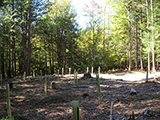
I head up the trail to check out the giant eastern hemlock and eastern white pine in this woods on the West Branch Nature Preserve. There’s a certain feeling of awe and wonder, an amazing spaciousness, when you take in this stand of nearly 200-year-old trees.
I head up the trail to check out the giant eastern hemlock and eastern white pine in this woods on the West Branch Nature Preserve. There’s a certain feeling of awe and wonder, an amazing spaciousness, when you take in this stand of nearly 200-year-old trees.
Hemlock and white pine are easily identified in winter. That’s because here in the Catskills, at least, they’re the only green trees in winter that grow naturally at lower elevations.
How can you tell these trees apart, so if you came upon one of them you would know which it is? Let’s check out location, needles, and bark to see the differences.
Location:
Hemlock is most often found on cooler hillsides and around gorges or wet areas. It’s very shade tolerant, so it can grow beneath other trees.
White pine can grow in wet areas, but it does best on well-drained sites. It doesn’t handle shade as well as hemlock, so it isn’t found in the understory unless the canopy is fairly open.
Needles:
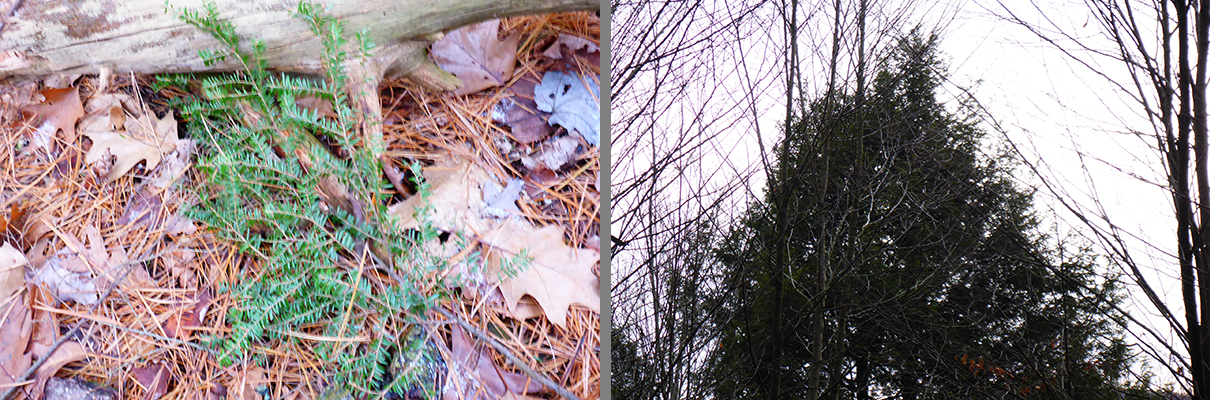
Hemlock needles are short, roughly 1/4 to 1/2 inch. They attach to the stem singly and are dark green. From the ground looking up into a tall tree, hemlock needles are present lower down on the tree and closer to the trunk, creating a thicker crown. When viewed from a distance, the tree’s foliage tends to have a nice taper, like a rounded Christmas tree.
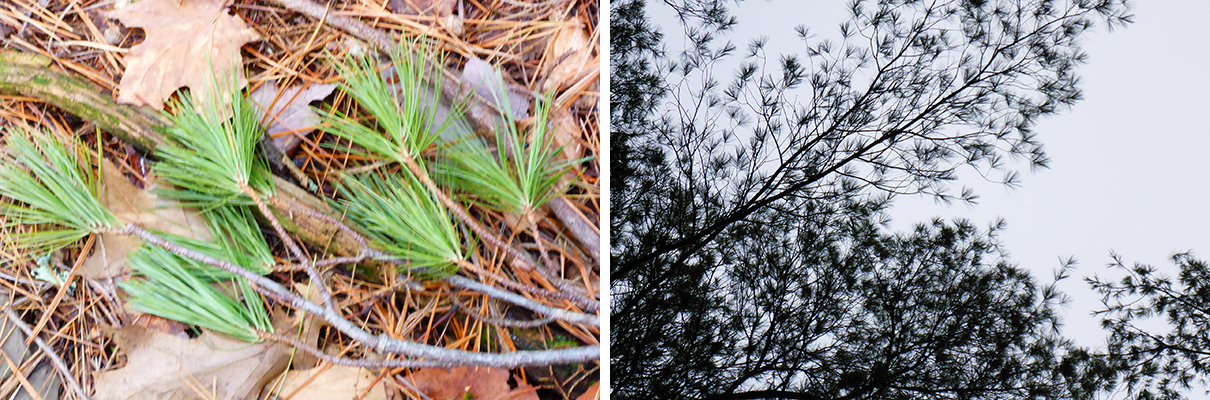
White pine needles are longer – 2 to 5 inches – and attach to the stem in bundles of 5. They’re a lighter green than hemlock. From the ground looking up into a tall tree, the branches with needles are more toward the top of the tree. This gives the tree a flat-top look, with the widest area of the crown near the top. The branches are more open and irregular than hemlock, and often one side of the tree has shorter branches than the other due to the effect of the prevailing wind shortening the branch length.
Bark:
Bark is important to know if you don’t want to crane your neck to look at distant needles. On hemlocks, the bark is somewhat rough even on smaller trees. It breaks into smaller, thinner, less blocky patterns than white pine, and it has a reddish tinge, especially underneath.
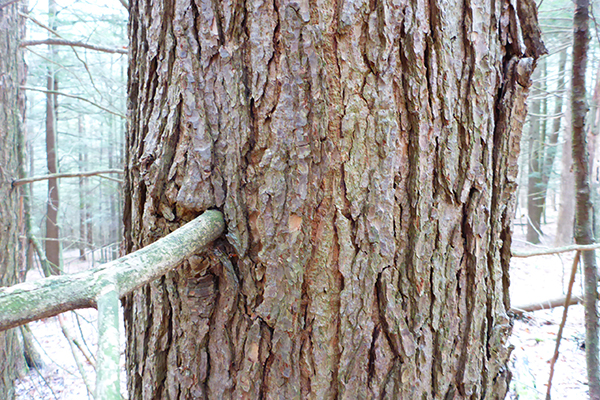
White pine bark can be very smooth on younger, faster growing trees, but it breaks into thick rectangular blocks on large trees. Look for these rectangles for an easy ID between hemlock and white pine.
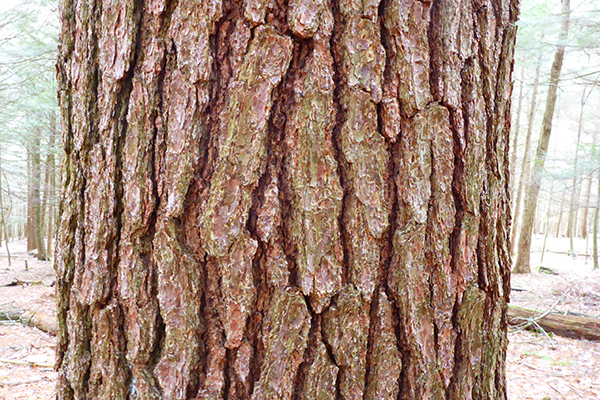
Armed with the above information try seeing if you can identify these two trees in your own woods or in a public forest near where you live. You can check out a tree ID activity on My Woodlot to help you.
Or check out some other conifers in a recent blog on Look-alike leaves: Red, White and Scotch Pine.