What’s that long tail on that wasp? Is it really boring into that tree’s bark? Why’s it doing that?
It was June 4, 2025. I was at Ward Pound Ridge Reservation in Pound Ridge, NY. I was helping Tyler Van Fleet (WAC’s East of Hudson Forestry Program Coordinator) and Trout Unlimited volunteers lead a Trout in the Classroom trout release field trip. Our guests were approximately one hundred 3rd and 4th graders from PS 30 in NYC, their teachers, and chaperones. This forestry field trip included three activities: release fingerling-sized trout into the Cross River; collect and identify benthic macroinvertebrates (aquatic insects that tell you about water quality); do a half-hour nature hike.
We split the students into groups, and I was the nature hike trail guide. The students were beyond excited. Every plant and animal encounter produced joyful shouts. But I knew a truly special find had been made when I heard a student yelling “ohh my-aa GOSH!!!”. I wheeled around and saw them pointing at the base of a dead tree.
It was not 1, but 2 female giant ichneumon wasps.
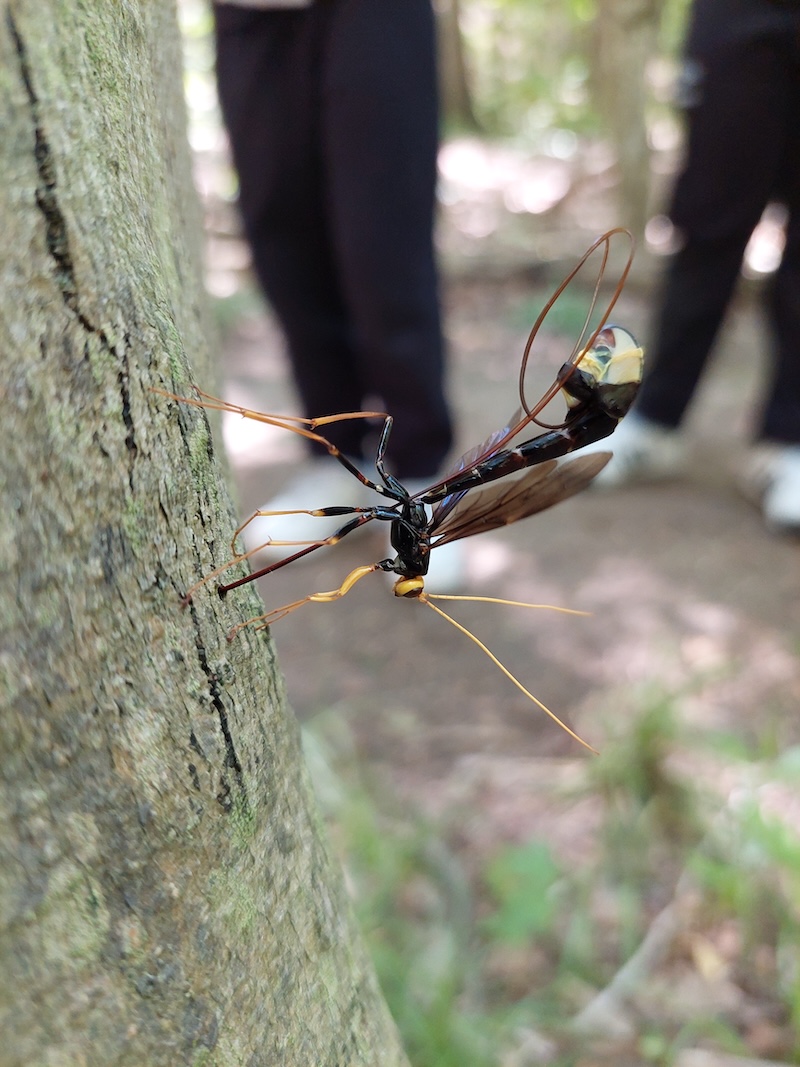
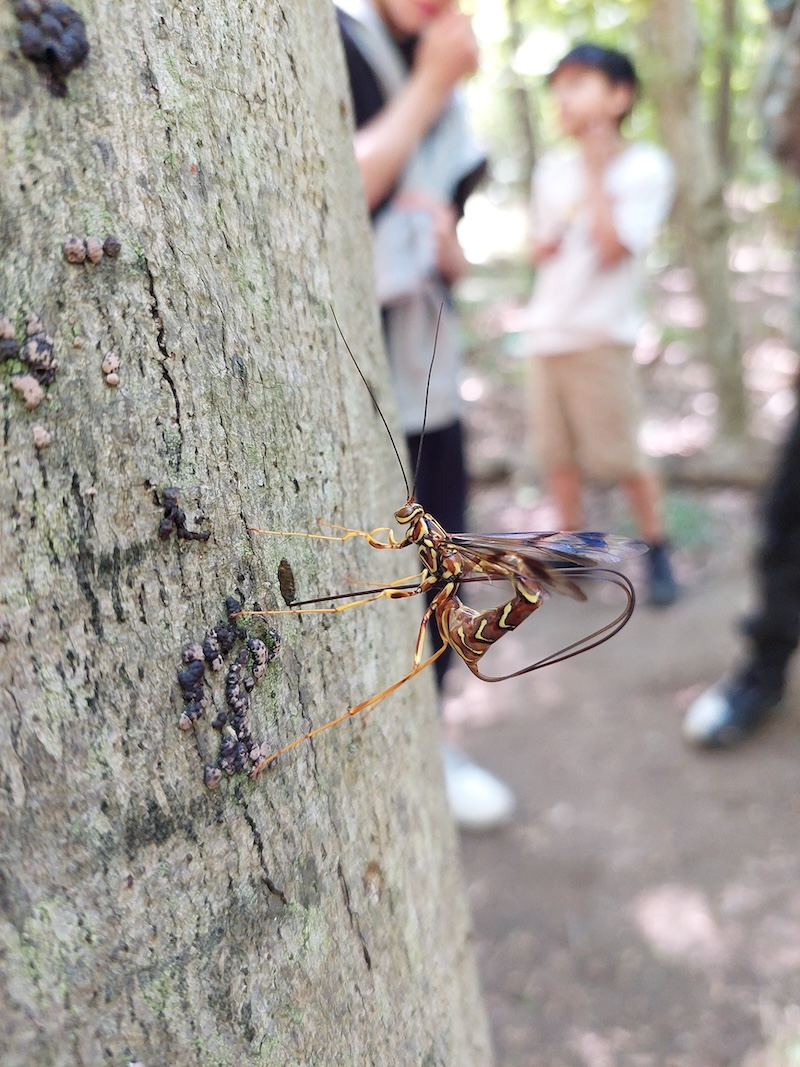
What was going on there? Well, the females were using their extra-long ovipositors to drill through the wood and lay an egg on a larva of Tremex columba (the pigeon horntail wasp). I’m not sure how the giant ichneumon wasp knows there is a horntail larva in the bark. At any rate, the Ichneumon egg turns into a larva that eats the horntail host. It pupates under the bark and emerges as an adult the following year. Apparently, Charles Darwin was quite disturbed by this behavior.
Female giant ichneumon wasps (Megarhyssa), also known stump stabbers, have some of the longest ovipositors of any insects (ranging 2-4 inches long), and they can be much longer than the insects themselves. As mentioned earlier, they parasitize horntail wasp larvae. Megarhyssa are part of the Ichneumonidae family, the most biodiverse wasp family in the world. Megarhyssa occur all over the world and are widespread throughout the United States. So don’t be surprised if you see one in the woods someday. Then you can disturb your friends or rather inform them about what these female wasps are doing.
I got my information about Ichneumonid wasps from the following links:
https://en.wikipedia.org/wiki/Ichneumonidae
https://en.wikipedia.org/wiki/Megarhyssa
https://www.knowyourinsects.org/Hymenoptera1_Ichneumonidae.html
If you are an educator and want to learn more about Forestry Field Trips, check out this link: https://nycwatershed.org/fieldtrips